


To understand the scientific truth behind Sabarimala, one would have to travel back millions of years, traversing the Kali Yuga and Dvapara Yuga, reaching close to the Treta Yuga.
During that period, the availability of rain in southern India was very low. The moisture formed in the Arabian Sea traveled to the Bay of Bengal, and likewise, the moisture formed in the Bay of Bengal reached the Arabian Sea and turned into rain. Therefore, the land between the two seas was arid and barren, lacking water and fertile soil. Plants and trees dried up, and the earth transformed into a place of punishment called famine, threatening life itself, making human life unbearable.
Parashurama, drawn to the doctrines of Lord Rama, descended to Kerala at that time with his weapon to create the Bhargavanilayam. On the land that had become as hard as rock without water, after conducting several studies, Shri Raman restored and purified Tatakavana, bringing forth the rain (Ganga). In that way, firmly grounded in that scientific perspective which granted salvation to the earth, Parashurama devised the course of actions.
In places where many scholars around the world tried and failed to discover the path to salvation, Parashurama, using Arya Siddhanta (Shri Rama Siddhanta), discovered the path of rain clouds (Milky Way). The rain clouds moved even over the area of present-day Sabarimala, where the air pressure is low, reached both seas, and condensed there to produce rain.
With the understanding that all the problems of life on this earth can only be solved by uniting the soil (Haran) and the nature of trees (Hari) to channel water, he established Ayankavu, the sacred groves of Sridharma Shastra, to sanctify the water.
That is, if the rain that falls in the sea is to fall on land, it is necessary to stop these rain clouds over the land. Therefore, since the height of the mountain ranges in the area where Sabarimala is located today is relatively low, they elevated them to the height of the rain clouds’ travel path (by planting and nurturing nature in eighteen mountain ranges and great trees) to stop the rain clouds and make it rain—a scientific marvel.
This scientific wonder was established only in South India, which is why our children’s curriculum includes that it rains because the mountain ranges block the rain clouds.
Since it was a project undertaken for the availability of water (Shabaram), South India was divided into the five Dravidian regions and the Shabari Peak was established as its water center. In this way, the land on both sides of the Western Ghats began to receive abundant rainfall and, along with the rivers originating from the Western Ghats, started to have water availability.
Next, what he did was to create a moral-duty plan for everyone to know this science and protect the trees, to ensure the safety of these eighteen mountains and the plants and trees year after year.
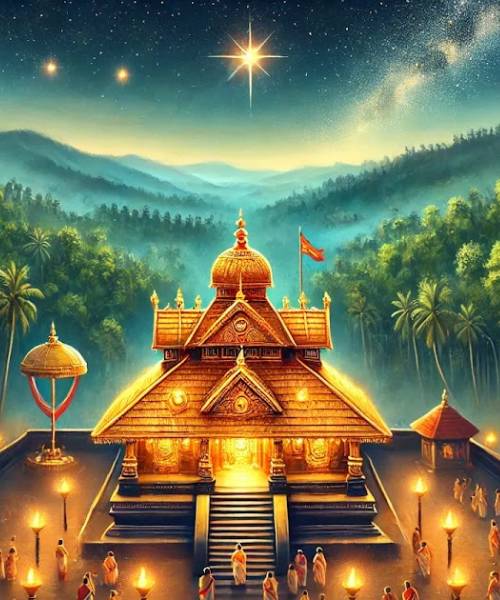
Thus, he established this scientific secret as a principle and reinforced it as yearly rituals and practices to carry out the methods.
For these karma programs, understanding those scientific truths, he called every person who reached there as ‘Ayyan’, representing them, and Parashuraman also named that installation as ‘Shasthav’.
To renew the Earth for the future security of generations, the era was divided into nine periods. The period in which the Mandala time begins is Vrischika, lasting from the 1st to the 41st day. This period is the most suitable time for afforestation and forest maintenance.
He researched and identified the most suitable farming methods for maintaining water as life essence in the hair of both sides of the Western Ghats (of the Panch Dravida region – South India) and for enriching biodiversity. He realized that in the eastern part of the Western Ghats, including Tamil Nadu, the most suitable crops are nine grains, and thus started cultivating them. In Kerala, according to the terrain, he established coconut cultivation and paddy fields that helped the water flow into the ground instead of being wasted as it reached the sea.
Forest conservation is necessary in the Western Ghats. However, in Kerala, for water conservation (for groundwater), coconut trees were planted to replace the cleared forests. Kerala is called so not because of the coconut trees themselves, but because it is a land where coconut trees need to be nurtured and maintained.
It is understood that the Sabarimala rituals are scientific methods for protecting these agricultural products, which is why coconuts and nine grains are symbolically placed in two bundles (Irumudikettu). Moreover, the rituals are arranged so that no harm comes to the roots of the plants when going barefoot.
The lighting of the Makaravilakku is a symbol of the assurance that the masses, who go to the eighteen hills for Sreedharma karmas, have fully implemented tree conservation across all the hill ranges by the end of the Mandala period. When the tree conservation is completed and the Makaravilakku is lit, that is when the return journey of the believers, with the chanting of mantras and the sound of temple bells, begins.
In short, whether you go to Sabarimala for a day or two with any other intention, it is of no use; during that entire period, you must return only after taking care of the trees there.

Over time, as these truths began to fade, deforestation and forest conservation came to a halt. When many people seized the forests and started cultivation, the great trees were threatened. It was Sri Manikantan who later understood this scientific truth of Sabarimala through a devoted life of celibacy. When water became scarce again in the Kali Yuga, Sri Manikantan prepared to restrain the Kalpantha (the complete destruction of the living world) and to protect the Maternal World (the animal world). Shri Manikandan took on the mission after realizing that his life goal was not merely the protection of a kingdom, but the preservation of water, which is essential for the existence of life in this world. Shri Manikandan is a scholar who devoted his life after Parashurama to remedy the fundamental ailment of the earthly realm (the availability of water necessary for the life of beings).
Sabarimala is not merely an exhibition center rooted in superstitions that spoil the land. The rituals and practices there are not just the physical procedures we see.